The Oklahoma Garage Shelter: Space-Saving Peace of Mind
If you have spent even one spring in Oklahoma, you know the feeling. It is that heavy, electric stillness that settles over the plains just before the sky turns a bruised shade of green. You hear the distant wail of a siren, and suddenly, the theoretical threat of a tornado becomes a very immediate reality. For generations, Oklahomans relied on the classic “fraidy hole” in the backyard—a damp, spider-ridden concrete box that required a terrifying dash through horizontal rain and hail to reach.
But times have changed. We have traded the old outdoor cellar for something far more sophisticated and practical: the underground garage storm shelter.
As someone who has watched the wall clouds rotate over Moore and felt the ground shake as an EF5 passed nearby, I can tell you that preparedness is not just a checklist; it is a way of life here. Today, the most intelligent way to protect your legacy and your family is through a shelter that lives where you do—inside your home’s footprint.

The Evolution of Tornado Protection in the Sooner State
Why has the underground garage shelter become the gold standard for modern Oklahoma homes? To understand that, you have to look at how we live today. Most of us do not have the sprawling acreage of our ancestors. We have suburban lots, meticulously landscaped yards, and Homeowners Association (HOA) rules that might frown upon a concrete mound in the middle of a manicured lawn.
Beyond aesthetics, there is the matter of physics and psychology. When a “tornado warned” storm is bearing down on your neighborhood, the last thing you want to do is grab your kids, your pets, and your emergency bag to run out into a barrage of golf-ball-sized hail.
The Convenience Factor
-
Zero-Footprint Design: These shelters are installed flush with your garage floor. You park your car right over them.
-
Immediate Access: You don’t have to leave the house. You simply step into the garage, slide the lid, and descend.
-
Protection for Assets: It isn’t just about people; an underground shelter in the garage keeps you close to your vehicles and your home’s structural core.
Engineering That Defies the Storm
You might wonder, “Is a hole in my garage floor really going to stop a 200-mph wind?” The answer lies in the engineering. A garage shelter is not just a hole; it is a precision-engineered steel or concrete vault designed to turn the earth’s natural mass into a shield.
At Oklahoma Shelters, we don’t believe in “good enough.” Our units are built to meet and exceed FEMA 320 and ICC-500 standards. But what does that actually mean for you when the wind starts to howl?
1. Material Strength
The body of a high-quality garage shelter is typically constructed from 10-gauge reinforced steel. The lids—the only part exposed to the potential debris of a collapsing house—are even beefier, often crafted from 1/4-inch steel plate. This isn’t just “sturdy”; it is tank-grade protection.
2. The Impact Test
Every design we offer has been put through the ringer at the Texas Tech Wind Science and Engineering Research Center. They literally fire 15-pound 2×4 wooden beams at these shelters at 100 mph to simulate flying debris. If it can’t stand up to that, it doesn’t belong in an Oklahoman’s garage.
3. The “Anti-Float” System
One of the biggest concerns with underground units is the water table. Oklahoma’s clay soil can hold moisture like a sponge. Without proper anchoring, an underground tank could theoretically “pop” out of the ground like a cork in a bathtub. We prevent this by using a rebar-reinforced anchoring system and pouring high-PSI concrete around the unit to ensure it stays exactly where it was put, indefinitely.
What Happens During the Installation?
I often talk to homeowners who are worried that installing a shelter will turn their home into a construction zone for weeks. In reality, the process is surprisingly surgical. If you were to watch our crews at work, you would see a choreographed sequence of events that takes your garage from “standard” to “fortress” in a single afternoon.
The Site Evaluation Before a shovel even touches the ground, we have to know what is beneath your feet. We look for utility lines (gas, water, electric) and assess the thickness of your current concrete slab. We want to ensure the shelter is placed in a spot that allows you to easily park your car over it while still leaving room for the lid to slide open.
The Precision Cut We use a diamond-blade wet saw to cut through your garage floor. Why “wet”? Because it keeps the dust to a minimum. We know you don’t want a layer of concrete powder on your tools and storage bins.
Excavation and Placement Once the slab is opened, we excavate the soil to the exact dimensions of the unit. The shelter is then lowered into the hole using heavy-duty equipment. We don’t just “drop it in.” We square it up and level it to ensure the sliding lid operates with the touch of a finger.
The Concrete Pour The gap between the shelter walls and the surrounding earth is filled with concrete. This serves two purposes: it anchors the unit against the “float” we mentioned earlier, and it provides a seamless, flush finish with your existing garage floor.
Navigating the Space: Sizes for Every Family
How many people do you need to protect? In Oklahoma, “family” often includes the neighbors who don’t have a shelter, the grandkids, and the golden retriever. We offer a variety of sizes to ensure no one is left out in the rain.
-
The Large (6-8 People): Perfect for the average family. It typically measures around 3′ x 7′ and is deep enough to sit comfortably.
-
The Extra-Large (9-12 People): A favorite for those who want a bit more “elbow room” or have a larger household.
-
The Jumbo (12-16 People): Often used for small businesses or multi-generational homes.
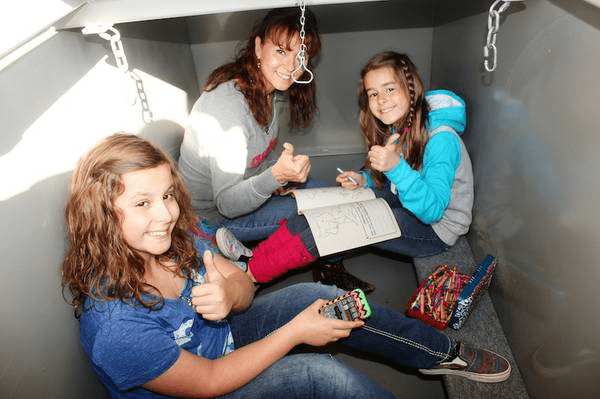
Each unit comes equipped with removable stairs and benches. Why removable? Because if you need to stay down there for an extended period, you want the flexibility to move things around. We even include a handrail for the seniors in your life who might find stairs a bit daunting during a high-stress situation.
Addressing the “What Ifs”: Safety Features You Might Not Think Of
Living through a tornado teaches you to think about the “worst-case scenario.” Most people ask: “What if my car is parked over the shelter when the house falls down?”
It’s a valid fear. If the house collapses and debris lands on your garage floor, you need to know you aren’t trapped.
The Sliding Lid and Emergency Jack
Our lids are designed to slide, not lift. This is critical. If a heavy object—like a piece of a roof or a tool bench—is sitting on the lid, it is much easier to slide it out from under the weight than to lift it against gravity. For the absolute worst scenarios, we provide an emergency hand winch or jack system. This gives you the mechanical advantage to move thousands of pounds of debris from the inside, ensuring you can always get out once the “all clear” is given.
Ventilation is Non-Negotiable
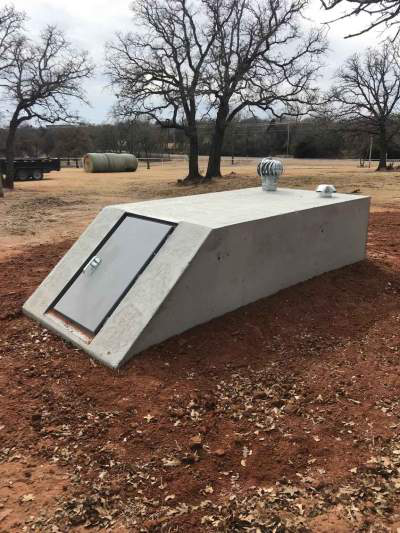
You aren’t just sitting in a box; you are breathing in one. FEMA standards require specific amounts of ventilation for every occupant. Our shelters feature vented lids that allow for constant airflow while remaining small enough to prevent dangerous debris from entering the living space.
The Financial Logic: More Than Just Safety
As a pragmatic Oklahoman, I know that every home improvement is also an investment. Does a storm shelter pay for itself? In this part of the country, the answer is a resounding “yes.”
-
Home Resale Value: Ask any local realtor. In Oklahoma City, Norman, or Edmond, a home with a pre-installed, high-quality storm shelter sells faster and for more money than one without. It is often the first question a buyer asks.
-
Insurance Incentives: Many insurance companies offer discounts on homeowners’ premiums for those who take proactive steps toward disaster mitigation.
-
The “Tax-Free” Perk: In Oklahoma, storm shelters are considered a tax-free product. This is a rare instance where the state encourages your safety by keeping more money in your pocket.
How to Prepare Your “Safe Space”
Once the shelter is installed, your job isn’t quite done. A shelter is a tool, and like any tool, it works best when it is prepared. I always tell my clients to treat their garage shelter like a second “mini-home.”
The Essentials Kit:
-
Lighting: Keep a high-quality LED lantern inside. Avoid candles—oxygen is precious in a small space.
-
Communication: A battery-powered NOAA weather radio is your lifeline. Don’t rely on your cell phone; towers often go down during big strikes.
-
Comfort: Keep a few heavy blankets and some “comfort items” for kids (a deck of cards or a favorite stuffed animal can lower the heart rate significantly).
-
Documentation: Keep a waterproof bag with copies of your insurance, IDs, and deeds.
Why Choose a Local Partner Like Oklahoma Shelters?
You could buy a “kit” online, but would you trust your life to a manual and a DIY weekend? Out here, we know that the soil in Tulsa is different from the soil in Altus. We understand the specific municipal codes in Norman and the permitting requirements in OKC.
We have spent years refining our installation garage Storm Shelter techniques to handle the unique challenges of the Oklahoma landscape. When you work with us, you aren’t just buying a steel box; you are hiring a team that has sat in those same shelters during the same storms you have. We know the stakes because we live here, too.
Final Thoughts: Don’t Wait for the Siren
If there is one thing I have learned after decades of Oklahoma springs, it is that a tornado is a terrible alarm clock. By the time you hear the sirens, the window for making a calm, rational decision about your family’s safety has already closed.
An underground garage shelter offers you the chance to be the person who stays calm. You aren’t the one scanning the horizon with a flashlight; you are the one comfortably seated with your loved ones, waiting for the “all clear” while the storm passes harmlessly overhead.
It is about more than just surviving a wind speed; it is about the peace of mind that comes from knowing you have done everything possible to protect what matters most.
Take the first step toward a safer home today. Our team is ready to help you navigate the options, from sizing to financing. We pride ourselves on clear communication and expert execution. You deserve a shelter that works as hard as you do.
Contact Oklahoma Shelters for a free, no-obligation consultation. Email us at: sales@oklahomashelters.net
Let’s make sure that the next time the sky turns green, your only worry is where you put the deck of cards. Stay safe, Oklahoma.