The Reality of Extreme Weather in Oklahoma is Out Here
Living in rural Oklahoma offers a sense of freedom rarely found in the city. You have space. You have quiet. You can see the stars at night.
But you also see the storms coming long before anyone else.
When you live out in the county, on a farm, or on large acreage, you face different challenges than city dwellers. This is especially true during tornado season.
In the city, community shelters might be nearby. Emergency response times are generally faster. Out here, you are often on your own.
When a tornado warning siren sounds—if you are close enough to hear one—you don’t have time to drive to town. You need immediate, reliable safety right on your property.
For generations, rural Oklahomans have relied on one material to protect their families from the fiercest winds on earth: concrete.
At Oklahoma Shelters, based in Oklahoma City and serving the entire state, we understand the unique needs of rural property owners. We believe that for wide-open spaces, concrete storm shelters remain the gold standard for protection.
Why Rural Properties Need Dedicated Solutions
A farmhouse on the plains faces the full, uninterrupted force of the wind. There are no skyscrapers or dense neighborhoods to break a tornado’s path.
If an EF-4 or EF-5 tornado tracks across open land, it can wipe a foundation clean.
Distance is a Factor
The primary reason rural residents need on-site shelters is distance. You cannot outrun a tornado in a vehicle. Trying to drive to a safer location is statistically one of the most dangerous things you can do during a severe storm. Safety must be accessible within seconds, not minutes.
Self-Reliance is Key
Rural living is about self-reliance. When the power goes out and roads are blocked by debris, you need a plan that doesn’t depend on anyone else. A robust, well-stocked concrete cellar provides that independence during an emergency.
The Concrete Advantage: Weight Wins
Why is concrete so prevalent in rural areas? It comes down to physics.
Tornadoes cause damage through intense wind speeds and rapidly shifting pressure. However, the biggest threat to life is flying debris. A high-end tornado can toss cars, tractors, and entire roofs through the air like toys.
To survive this, you need a shelter that will not move.
Massive Weight
Concrete shelters are incredibly heavy. A typical precast underground concrete shelter weighs many thousands of pounds. Once it is set in the ground and buried, the surrounding earth adds even more stabilizing weight.
This mass is crucial. It ensures the shelter will not be lifted out of the ground by the immense suction of a tornado vortex. Lighter materials, if not anchored perfectly, can become compromised. Concrete relies on gravity and mass, which never fail.
Superior Durability
Concrete is practically indestructible against weather. It doesn’t rot. It doesn’t rust. Termites can’t eat it.
For a rural property owner looking for a “one-and-done” investment, concrete is ideal. You install it, and it is there for decades. Many older farm properties still have functional concrete “root cellars” built 50 or more years ago that would still provide adequate protection today.
According to the National Weather Service (NWS), Oklahoma consistently ranks among the highest states for tornado activity. The data proves the need for permanent, heavy-duty solutions that stand the test of time.
Types of Concrete Shelters for Rural Land
When you have acreage, you have more options for placement than a homeowner on a small city lot. You are not restricted by tight property lines or extensive underground city utilities.
At Oklahoma Shelters, we offer concrete options that are perfect for rural applications.
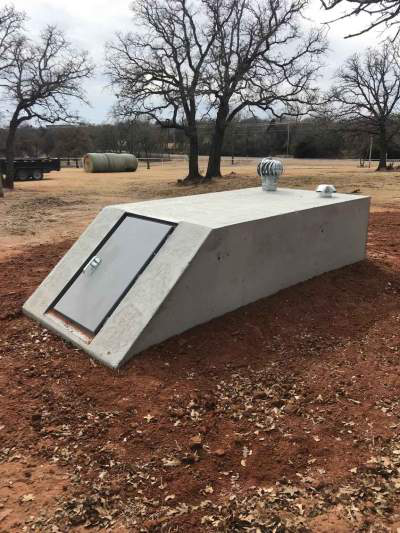
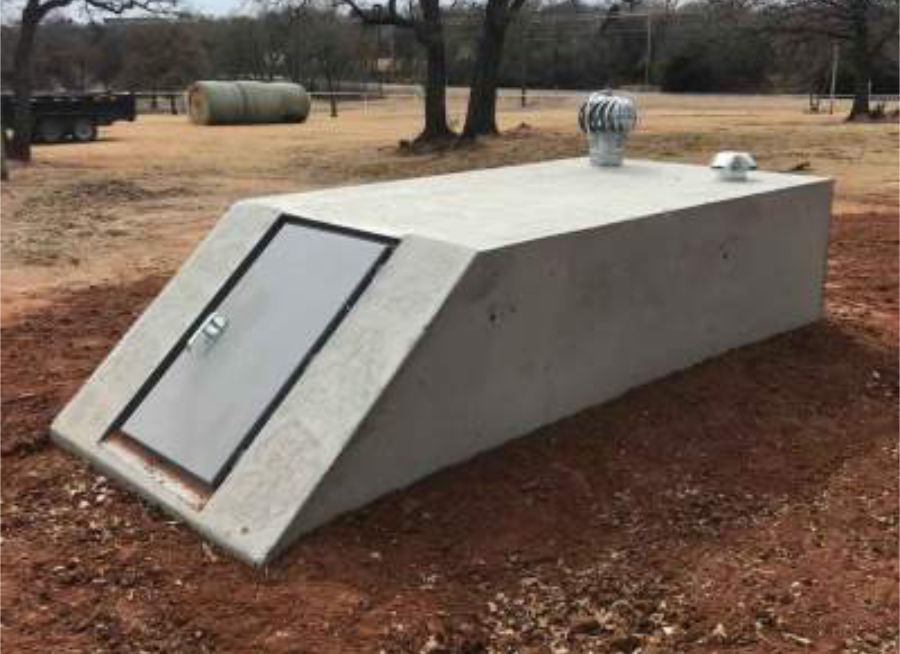
The Slope-Front Concrete Shelter
This is the classic “storm cellar” design you see on farms across the Midwest.
It is partially buried underground. The entrance door is angled (sloped) above the ground, usually leading down a few concrete steps into the main chamber.
- Easy Access: The stairs make it easy for people of most ages and pets to get inside quickly.
- Dual Purpose: In rural areas, these often double as traditional root cellars for storing canned goods or supplies, as they stay cooler underground.
- Visibility: The above-ground entrance is easy to locate, even in the dark or pouring rain.
The Flat-Top Concrete Shelter
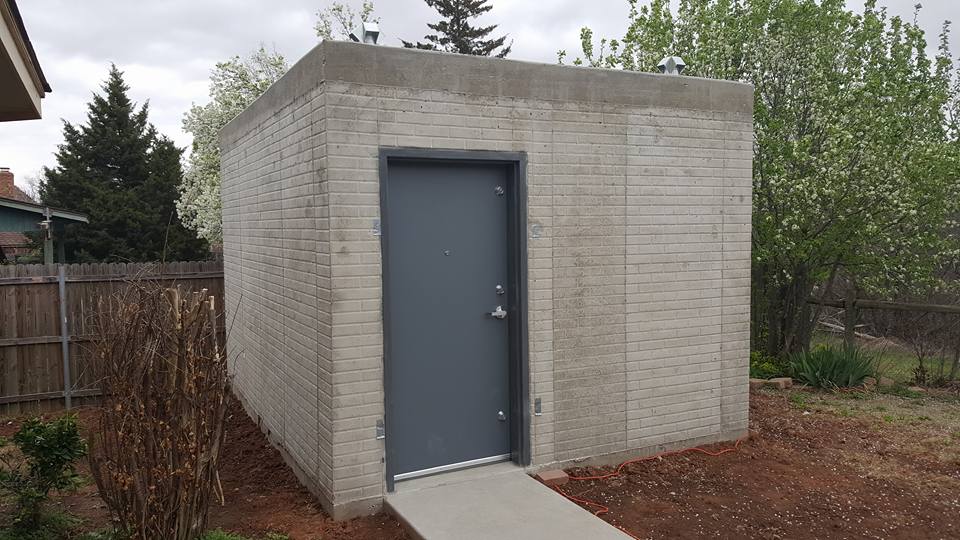
These are designed to be buried completely underground, usually in a yard or near a patio. The top of the shelter is flush with the ground.
- Low Profile: It doesn’t interrupt the landscape view. You can mow right over the top of it.
- Space Saving: While space isn’t always an issue on farms, some prefer to keep the shelter tucked away near the main house door for quick access without running across a large yard.
Both types are precast. This means they are poured and cured in a controlled environment at a manufacturing facility, ensuring consistent strength before they ever reach your property.
The Installation Process on Acreage
Installing a concrete shelter requires heavy equipment.
A large hole must be excavated. Then, a heavy-duty crane truck is needed to lower the massive concrete structure into place. Finally, the earth must be backfilled around it.
Easier Rural Access
On a city lot, dodging fences, power lines, and narrow driveways can make installing these heavy units difficult.
On a rural property, access is rarely an issue. We can easily bring in the necessary excavator and crane truck without worrying about damaging a neighbor’s fence. This often makes the installation process faster and smoother on country properties.
Site Selection Freedom
You have the freedom to choose the best spot. We recommend placing the shelter reasonably close to the main house so you don’t have far to run. However, you don’t have to worry about hitting a municipal sewer line in the middle of your back forty.
Meeting Federal Safety Standards
It is not enough to just pour concrete in a hole. A storm shelter must meet rigorous engineering standards to ensure it can withstand an EF-5 tornado.
The benchmark for storm shelter safety is established by FEMA (Federal Emergency Management Agency) and the ICC (International Code Council), specifically the ICC 500 standard.
FEMA guidelines for safe rooms emphasize the necessity of a structure that provides “near-absolute protection.”
Our concrete shelters are designed with these standards in mind.
- Reinforced Concrete: Our shelters are not just concrete; they are reinforced with steel rebar. This provides tensile strength, ensuring the concrete doesn’t crack or crumble under impact.
- High PSI: We use high-strength concrete mix designed to handle immense pressure.
- Secure Doors: The door is often the weakest point of any shelter. Our concrete shelters feature heavy-gauge steel doors with multi-point locking systems, designed to resist high-velocity debris impacts.
Why Choose Oklahoma Shelters?
We are Oklahomans. We know what the sky looks like in May. We know the feeling in the pit of your stomach when the air pressure drops.
We are located in Oklahoma City, but we service the entire state, from the panhandle to the Red River. We are accustomed to working on rural properties and understand the logistics involved.
No-Hassle Process
We handle the heavy lifting. We excavate the site, deliver the precast unit, install it, and backfill the area. We want to make the process as simple as possible for you.
Proven Designs
We only sell shelters that we would trust with our own families. Our range of storm shelters includes not just concrete, but also steel garage units. However, when a customer calls from a large rural property asking for the most durable, long-lasting outdoor solution, we almost always recommend concrete.
Secure Your Legacy
Living out in the country is about building a legacy on your own land. Part of protecting that legacy is ensuring your family is safe when nature turns violent.
Don’t rely on luck. Don’t hope that the storm will turn at the last minute.
A concrete storm shelter is an investment in peace of mind. When the warnings are issued, you won’t panic. You will just open the heavy steel door, walk down the steps, and wait for the danger to pass, knowing you are surrounded by thousands of pounds of reinforced protection.
Get the protection that is as tough as the Oklahoma landscape.
Call Oklahoma Shelters today at (405) 367-7901 for a free consultation. Let us help you find the perfect concrete solution for your rural property.
10 PAA Questions and Answers for Concrete Storm Shelters
1. Why are concrete storm shelters considered the “gold standard” for rural properties in Oklahoma? Concrete is considered the gold standard because its massive weight ensures the shelter is not lifted out of the ground by a tornado’s immense suction. It also offers superior durability, as it is virtually indestructible against weather, rust, and rot, making it a reliable, long-term investment.
2. Why do rural Oklahomans need on-site storm shelters rather than relying on community shelters? On-site shelters are essential in rural areas because the distance to city community shelters and the slower emergency response times make reliance on them dangerous. Safety must be accessible within seconds, as trying to drive to a safer location during a severe storm is statistically one of the most dangerous actions.
3. How does the massive weight of a concrete storm shelter ensure protection during a tornado? The massive weight of a precast concrete shelter, combined with the stabilizing weight of the backfilled earth, keeps the structure firmly anchored. This mass relies on gravity to resist the immense uplift and suction forces generated by a tornado vortex.
4. What is the difference between a Slope-Front and a Flat-Top concrete storm shelter? A Slope-Front shelter is the classic storm cellar design, partially buried with an angled, above-ground entrance and steps, which makes for easy access. A Flat-Top shelter is buried completely underground with the top surface flush to the ground, offering a low-profile design that does not interrupt the landscape.
5. Do concrete storm shelters meet federal safety standards for tornado protection? Yes, reputable concrete storm shelters are engineered to meet rigorous safety benchmarks, including FEMA guidelines and the ICC 500 standard, which ensure the structure can provide “near-absolute protection” against an EF-5 tornado.
6. What material is used to reinforce concrete storm shelters for maximum protection? Concrete shelters are reinforced with steel rebar. This provides critical tensile strength, ensuring the concrete does not crack or crumble under the extreme pressure and high-velocity impacts of flying debris during a storm.
7. What is the weakest point of a storm shelter, and how is it secured in concrete designs? The door is often the weakest point. Concrete shelters feature heavy-gauge steel doors equipped with multi-point locking systems that are specifically designed to resist high-velocity debris impacts.
8. Can a slope-front concrete shelter be used for purposes other than just tornado safety? Yes, the slope-front design often doubles as a traditional “root cellar” in rural areas. The underground placement maintains a cool, stable temperature, making it ideal for storing canned goods and other non-perishable supplies.
9. Is the installation of a concrete storm shelter easier in a rural location than a city lot? Installation is generally easier on rural properties because the acreage provides superior access for the necessary heavy equipment (excavator and crane truck). This freedom avoids the logistical difficulties of navigating narrow driveways and avoiding extensive underground city utilities.
10. How long can a properly installed concrete storm shelter last on a property? Concrete shelters are built for extreme longevity. Since the material doesn’t rot or rust, and it is reinforced for strength, a concrete shelter can remain functional and provide adequate protection for many decades, often lasting 50 years or more.